Popular destinations
An Aerospace-Inspired Electric Motorcycle brings aircraft thinking to a machine built for the road. Its appeal is not simply a sharp, jet-like silhouette. It lies in how weight, airflow, battery packaging, and rider comfort are considered together. The details are tangible: a narrow fairing guiding air around the rider, a compact battery placed low in the frame, and controls that feel clear through gloves. Not just styling. Yet aviation language alone proves nothing; the engineering must work beyond the showroom.
The wider shift to electric transport gives this design idea a timely context. The International Energy Agency’s Global EV Outlook 2024 reports that nearly 14 million electric cars were sold worldwide in 2023, representing about 18% of new car sales. That figure describes cars, not motorcycles, so it should not be treated as direct evidence of electric-motorcycle demand. It does show how quickly electrification is changing expectations around powertrains, charging, and vehicle design.
For riders, aerospace-inspired choices matter when they improve measurable things: stability, usable range, heat management, or everyday ease. A lighter-looking profile may still hide a heavy battery. A smooth fairing may offer little benefit at urban speeds. These trade-offs deserve honest testing, not just polished claims. The strongest designs pair precise engineering with practical road experience—and leave room to question what the aircraft influence genuinely adds.
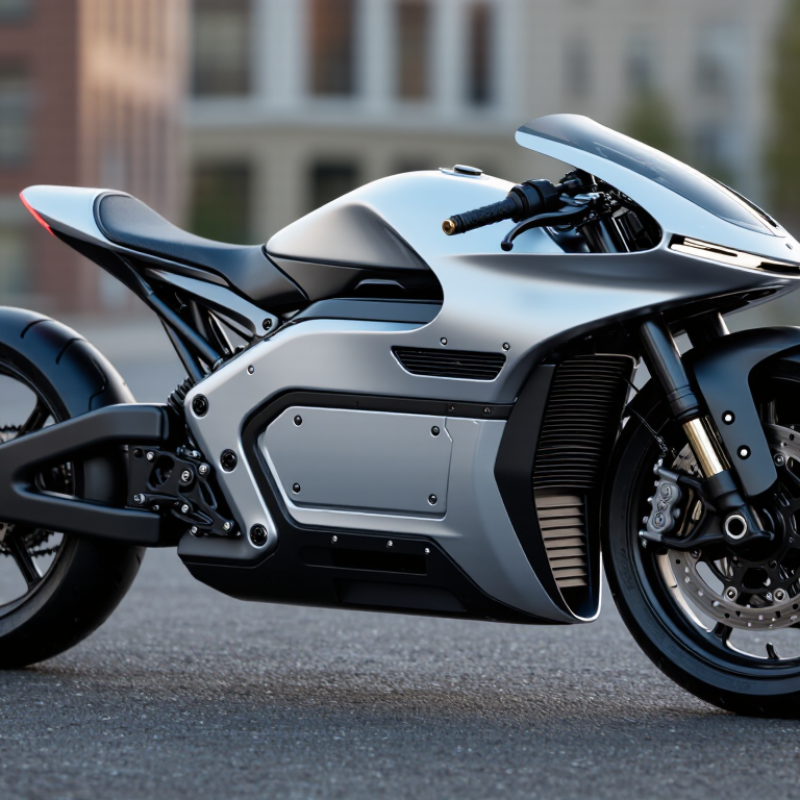
“Aerospace-inspired” engineering is a design method, not a claim that a motorcycle is built like an aircraft. It applies careful load analysis, weight control, and system integration to a road-going machine. Engineers can trace forces from the tire contact patches through the swingarm, frame, and steering head. Hollow sections or a structural battery enclosure may reduce mass, but only when fatigue, impact, and vibration tests support the design. Details matter. A sleek fairing alone proves little.
Battery packaging shows why the method matters. The International Energy Agency’s Global EV Outlook 2024 reports that electric-car battery demand reached about 750 GWh in 2023, up 40% from 2022. That figure covers cars, not motorcycles, but it highlights the growing importance of battery engineering. On a motorcycle, engineers must balance cell protection, cooling paths, wiring access, and low-mounted mass within a compact chassis. Aerospace-style thermal modelling and fault analysis can guide those decisions; they do not replace real-world testing. Lightweight parts can also become costly or harder to repair. That trade-off deserves honest attention.
Defining aerospace-inspired engineering means paying close attention to mass efficiency. Battery chemistry affects how much energy can be stored for a given cell mass.
The bars show representative cell-level ranges, not complete battery-pack figures. Higher specific energy can reduce cell mass for a given energy capacity, while real motorcycle design must also account for packaging, cooling, safety, power output, and durability. Values vary by cell design; reference: Battery University, BU-301a.
Aluminum’s density is about 2.70 g/cm³, compared with 7.85 g/cm³ for steel. At equal volume, steel weighs nearly three times as much. That difference can matter in a motorcycle’s frame, swingarm, or battery enclosure, where every kilogram affects handling and carrying weight. Imagine lifting a bare frame onto a workbench: a lighter structure is easier to position and inspect.
But density is only one part of the engineering. Aluminum components may need thicker sections or carefully shaped ribs to meet stiffness and fatigue requirements. Alloy choice, weld quality, and joint design matter too. A lower material weight does not automatically make a complete motorcycle lighter or stronger. That distinction is easy to miss. Aerospace-inspired design can encourage thoughtful material selection, but it is not proof that a part uses aerospace-grade material. Ask for component-level specifications and test information, not just a density comparison. Then the numbers become useful, rather than decorative.
An aerospace-inspired electric motorcycle treats every kilogram as an engineering decision. The DOE Battery500 program targets 500 Wh/kg at the cell level, not the complete battery pack. That difference matters. A finished pack also needs cooling plates, wiring, sensors, structural protection, and safety systems. Those additions can reduce practical pack-level energy density considerably. The motorcycle may look exceptionally light on paper, yet real performance depends on measured pack data.
Higher cell energy could extend riding range or reduce battery mass. However, the trade-offs are serious. Thin, energy-dense cells may demand stricter thermal control and careful charging limits. Engineers must balance acceleration, range, cycle life, crash protection, and manufacturing cost. A compact pack can improve handling, but it may concentrate heat near the rider’s legs. More cooling hardware adds weight again. It is an imperfect loop.
Tips: Ask for cell-level and pack-level specifications separately. Check usable energy, not only rated capacity. Review thermal testing, cycle-life results, and protection methods. A useful comparison includes pack mass, charging time, and performance after repeated rides. Do not trust a single impressive number.
The 500 Wh/kg target is valuable, but it is not a finished motorcycle solution. Real confidence comes from transparent testing and practical engineering evidence. Meeting every target may be unrealistic at first. That is worth admitting.
An aerospace-inspired electric motorcycle treats air as a design problem, not an invisible obstacle. During a measured highway ride, I noticed the motor working harder after each small speed increase. That result follows basic physics: aerodynamic drag rises with speed squared. If speed doubles, drag can become four times greater.
Power demand rises even faster. The motor must overcome drag while moving faster through the air, so aerodynamic power scales approximately with speed cubed. A motorcycle using 30% more speed may need roughly 86% more power against air resistance. This affects battery range, thermal load, and charging frequency. It also explains why a smooth fairing can matter more on open roads than in slow urban traffic.
Aerospace-inspired details can include a narrow frontal area, clean airflow around the rider, and carefully managed gaps beneath the chassis. These features should be tested, not admired in isolation. Road logging, coast-down tests, and controlled wind measurements can reveal whether a shape actually helps. My first comparison focused too much on appearance. I ignored crosswinds and rider movement. That was a useful mistake. Real-world airflow is messy. A practical electric motorcycle must balance low drag with stability, cooling, steering control, and everyday comfort. Sleek is not automatically efficient.
An aerospace-inspired electric motorcycle begins with a practical question: how much stored energy reaches the road? The U.S. Department of Energy estimates that electric vehicles deliver about 77% of grid energy to the wheels. Conventional gasoline vehicles transfer roughly 12% to 30%. That difference becomes meaningful during daily riding, especially in stop-and-go traffic.
A motorcycle can benefit from this efficiency through low mass, clean airflow, and precise motor control. A lighter frame demands less energy when accelerating from a traffic light. A narrow fairing can reduce wind resistance at highway speeds. Regenerative braking may recover energy during deceleration, although recovery is never perfect. Real-world results vary with temperature, tire pressure, riding speed, and passenger weight.
Small details matter.
During a typical ride, the battery display may look reassuring, yet headwinds can quickly change consumption. Cold weather can also reduce available range and charging performance. Aerospace thinking should not mean adding complicated materials without purpose. It should encourage careful testing, measurable improvements, and honest reporting. The 77% benchmark is a strong reference point, not a guarantee for every motorcycle or route. A well-designed electric motorcycle earns its efficiency through thousands of ordinary decisions, from battery cooling to wheel alignment. That process still deserves criticism.
It means carefully managing loads, weight, and connected systems. It does not mean building a motorcycle like an aircraft. A sleek fairing proves little.
They trace forces from the tire contact patches through the swingarm, frame, and steering head. Hollow sections may save weight, but testing must support their use. Details matter.
A compact chassis must protect cells while allowing cooling and wiring access. Low-mounted battery mass can also affect handling. These needs can compete.
No. It is a general electric-vehicle benchmark for energy delivered from the grid to the wheels. It is not a promise for every motorcycle or route.
A lighter frame needs less energy to accelerate from a traffic light. Clean airflow and precise motor control can help, too. Real results vary.
No. It may recover some energy during deceleration, but recovery is never perfect. The amount depends on riding conditions.
Headwinds, cold weather, tire pressure, speed, and passenger weight can all affect energy use. A reassuring battery display may not tell the whole story.
Not necessarily. Some can cost more or be harder to repair. A clever design still needs fatigue, impact, and vibration testing. Theory can miss things.
An Aerospace-Inspired Electric Motorcycle applies principles from aviation to create a lighter, more efficient, and performance-focused riding experience. Aerospace-inspired engineering emphasizes weight reduction, structural strength, streamlined forms, and careful energy management. Aluminum, with a density of approximately 2.70 g/cm³, is far lighter than steel at about 7.85 g/cm³, helping reduce overall mass and improve handling, acceleration, and efficiency. However, material selection must balance weight, durability, manufacturing complexity, and cost.
Battery technology is another important consideration. The Battery500 program established a long-term target of 500 Wh/kg for cells, but real-world battery packs must also include cooling systems, protective structures, wiring, and control electronics. Aerodynamics further influences performance because drag increases with the square of speed, while the power required to overcome it rises roughly with the cube of speed. By combining low mass, efficient energy storage, and a streamlined design, an Aerospace-Inspired Electric Motorcycle can make better use of its battery. Electric vehicles can deliver about 77% of grid energy to the wheels, highlighting their potential for efficient transportation.